



-
At a glance
Sector
Healthcare
Platforms
Web · iOS · Android · WhatsApp
Modules
9
Integrations
8
Screens
5
Total duration
23 weeks
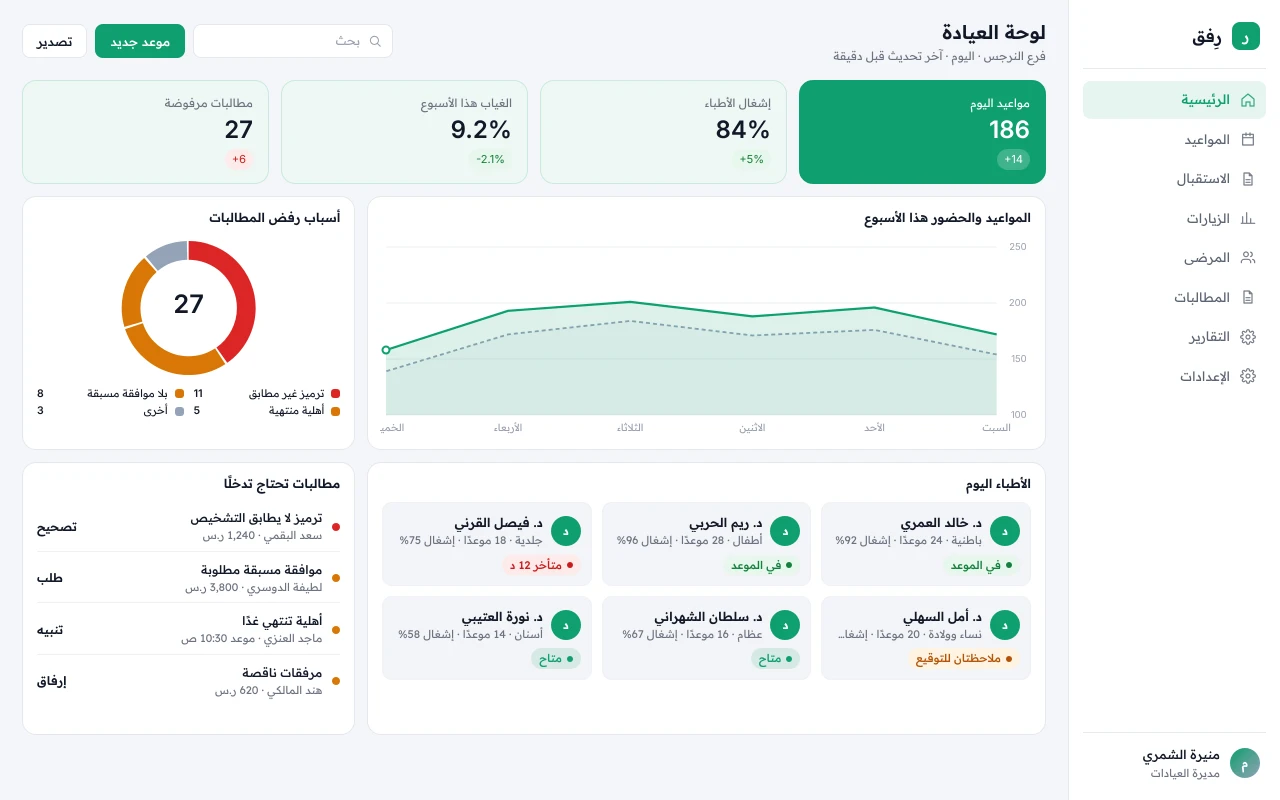
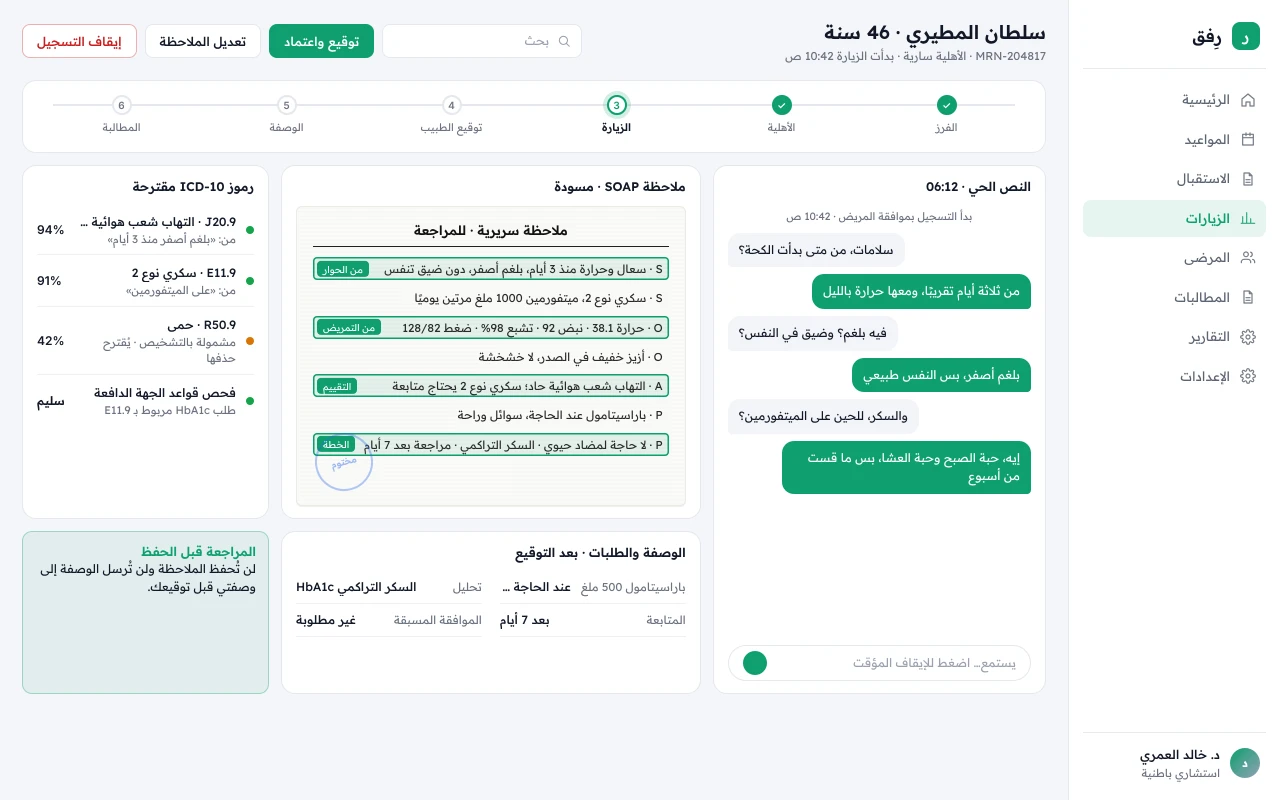
Rifq books patients on WhatsApp and the app and triages their symptoms before the visit, then listens to the doctor-patient conversation and drafts a structured SOAP note that the doctor reviews and signs; after the visit it explains the condition and treatment to the patient in plain language, from content the doctor approves. Prescriptions go out through Wasfaty, eligibility and pre-authorisation run through NPHIES, and the clinic manager sees utilisation, no-shows and rejected claims on one dashboard.
-
Challenge
-
01
Booking runs on calls and WhatsApp messages answered by hand at the front desk, so requests sent after hours are lost.
-
02
Doctors spend much of the visit typing instead of facing the patient, and finish their notes after hours.
-
03
Claims are rejected in NPHIES for lapsed eligibility, a pre-authorisation not requested in time, or codes that do not match the diagnosis.
-
04
No-shows run high, and managers cannot see which doctors and clinics lose hours or where revenue leaks.
Who it is built for
-
Patient
Books on WhatsApp in a minute and knows when to come and which clinic to see
-
Doctor
A note ready to review when the visit ends, with codes and prescription without re-keying
-
Front desk
A clear queue and eligibility checked before the patient arrives
-
Claims officer
A complete claim before it goes to NPHIES, and a clear reason if it is rejected
-
Clinic manager
Utilisation, no-shows and rejected claims per doctor and branch
-
Modules
What the system does
Connected modules working on one set of data.
-
01
Smart booking
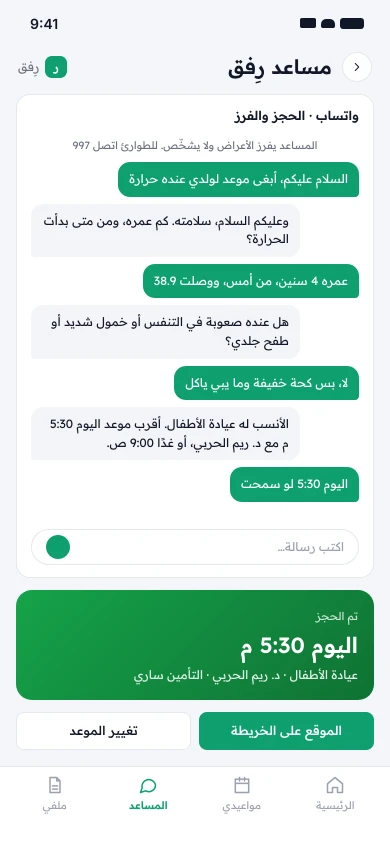
Book, reschedule and cancel on WhatsApp and the app, with a waitlist that refills cancelled slots
-
02
Symptom triage
Guided pre-visit questions pick the right specialty and flag emergencies at once
-
03
Ambient scribe
Turns the doctor-patient conversation into a structured SOAP note the doctor reviews and signs
-
04
Coding & e-prescription
ICD-10 suggestions, and Wasfaty prescriptions once the doctor signs
-
05
Eligibility & pre-auth
Coverage checked before the visit; pre-authorisation and claims sent through NPHIES
-
06
Front desk & queue
Check-in, queue numbers and a waiting-room screen per clinic
-
07
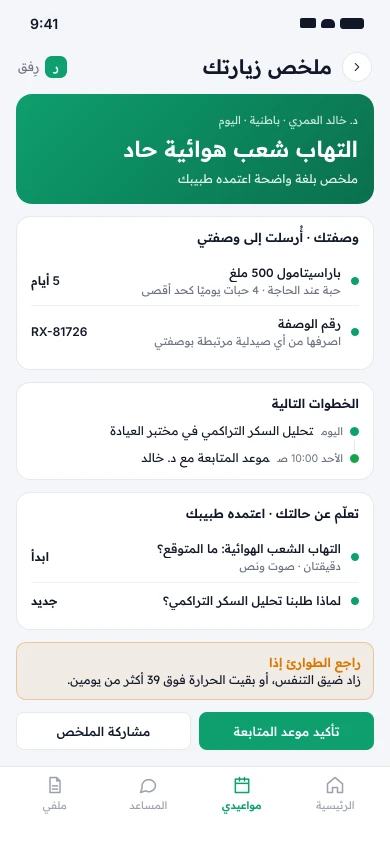
Results & follow-up
Lab results reach the patient after doctor approval, with follow-up and dose reminders
-
08
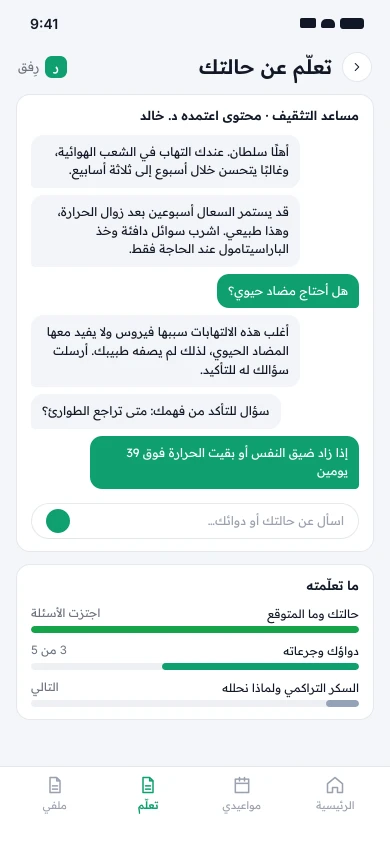
AI patient education
After each visit the patient gets a plain explanation of their condition, medicines and diet, as text or voice, from doctor-approved content, with short questions that confirm understanding
-
09
Manager dashboard
Utilisation, no-shows, rejected claims and revenue per doctor and branch
Where the AI works
-
AI · 01
A speech-to-text model tuned for Saudi dialects and mixed Arabic-English medical terms, separating the doctor’s voice from the patient’s.
-
AI · 02
A private in-Kingdom language model drafts the SOAP note from the transcript and suggests ICD-10 codes, linking each suggestion to the sentence it came from; nothing is saved until the doctor signs.
-
AI · 03
A WhatsApp triage assistant asks protocol-based questions, sends emergencies straight to the 997 ambulance line and never gives a diagnosis.
-
AI · 04
Two operational models: one scores each appointment’s no-show risk and sends an extra reminder or offers the slot to the waitlist; the other scores a claim’s rejection risk before it goes to NPHIES.
-
AI · 05
Patient-education assistant: an in-Kingdom language model grounded only in a content library approved by the clinic’s doctors. It turns the signed care plan into plain Arabic matched to the patient’s age and reading level, as text or voice, asks short teach-back questions to confirm understanding, sends dose reminders, and hands any red-flag symptom or question outside approved content to the doctor at once.
-
Screens
The system as the client's team and customers use it.
-
Architecture
Independent services, in-Kingdom data, and integrations over documented APIs.
Channels
- WhatsApp bot: Booking, triage & reminders
- Patient app: iOS & Android
- Clinic web app: Doctor, desk & manager
- Room capture: Exam-room microphone
Edge
- API gateway: Routing & WAF
- Identity: Nafath & staff roles
- Realtime gateway: Encrypted audio stream
Services
- Scheduling: Slots & queue
- Encounter service: Visit, note & sign-off
- Orders & Rx: Prescriptions & labs
- Revenue cycle: Eligibility, pre-auth & claims
- Notifications: Reminders & results
AI
- Arabic ASR: Speech-to-text & diarisation
- Clinical LLM: SOAP note & ICD-10
- Triage agent: Protocol-based triage
- Risk models: No-show & denial risk
- Education agent: Grounded patient education
Data
- PostgreSQL: Scheduling & billing
- FHIR store: Clinical record
- Object storage: Short-lived audio, in-Kingdom
- Content library: Doctor-approved content
Integrations
- NPHIES: HL7 FHIR
- Wasfaty: E-prescriptions
- Nafath: Patient identity
- Lab LIS: Lab results
- WhatsApp API: Outbound messages
Connections
- WhatsApp bot to API gateway
- Patient app to API gateway
- Clinic web app to API gateway
- Room capture to Realtime gateway: WebSocket
- API gateway to Identity
- API gateway to Scheduling: REST
- API gateway to Encounter service
- API gateway to Revenue cycle
- Realtime gateway to Arabic ASR: audio
- Arabic ASR to Clinical LLM: transcript
- Scheduling to Triage agent
- Scheduling to Risk models
- Revenue cycle to Risk models
- Encounter service to Clinical LLM
- Encounter service to Orders & Rx
- Encounter service to FHIR store
- Revenue cycle to PostgreSQL
- Arabic ASR to Object storage
- Orders & Rx to Wasfaty
- Orders & Rx to Lab LIS: HL7
- Revenue cycle to NPHIES: FHIR
- Identity to Nafath
- Scheduling to Notifications
- Notifications to WhatsApp API
- Encounter service to Education agent: care plan
- Education agent to Content library: RAG
- Education agent to WhatsApp API
Stack
- Next.js
- NestJS
- Flutter
- PostgreSQL
- HAPI FHIR
- Redis
- Python · FastAPI
- vLLM
- Kubernetes
-
Workflow
The visit journey
-
01
Book & triage
PatientWhatsApp · Triage agent
-
02
Eligibility check
AutomaticNPHIES
-
03
Reminder & confirmation
AutomaticNo-show model · WhatsApp
-
04
Check-in & vitals
Front desk & nurseQueue · Clinic app
-
05
Consultation with the scribe
Doctor & patientArabic ASR · Clinical LLM
-
06
Review & sign
DoctorEncounter service
-
07
Prescription & labs
Automatic after sign-offWasfaty · Lab LIS
-
08
Explain the condition and treatment
Automatic, from approved contentEducation agent · Patient app
-
09
Pre-auth if needed, then the claim
Claims officerNPHIES
-
10
Results & follow-up
Doctor, then automaticPatient app · WhatsApp
-
Data & API
The core entities and relations, and a live example from the API.
Patient
- iduuidPK
- national_idtext
- mrntextunique
- nametext
- birth_datedate
- phonetext
- scribe_consentboolean
Coverage
- iduuidPK
- patient_iduuidFK
- payer_idtext
- member_notext
- classtext
- eligible_untildate
- checked_attimestamptz
Appointment
- iduuidPK
- patient_iduuidFK
- doctor_iduuidFK
- slot_attimestamptz
- channelenum(whatsapp,
app, desk) - statusenum
- triagejsonb
- no_show_riskreal
Encounter
- iduuidPK
- appointment_iduuidFK
- transcript_keytext
- soapjsonb
- statusenum(draft,
signed) - signed_byuuidFK
- signed_attimestamptz
Diagnosis
- iduuidPK
- encounter_iduuidFK
- icd10text
- sourceenum(ai,
doctor) - confidencereal
- evidencetext
- acceptedboolean
Prescription
- iduuidPK
- encounter_iduuidFK
- wasfaty_reftext
- itemsjsonb
- statusenum
- issued_attimestamptz
LabResult
- iduuidPK
- encounter_iduuidFK
- test_codetext
- valuetext
- flagenum
- approved_byuuid
- released_attimestamptz
Claim
- iduuidPK
- encounter_iduuidFK
- coverage_iduuidFK
- nphies_reftext
- preauth_reftext
- amountnumeric
- statusenum
- denial_reasontext
EducationPlan
- iduuidPK
- encounter_iduuidFK
- topicstext[]
- reading_levelenum
- channelenum
- teachback_scoreint
- approved_byuuidFK
- Encounter 1—1 EducationPlan
- Patient 1—∞ Coverage
- Patient 1—∞ Appointment
- Appointment 1—1 Encounter
- Encounter 1—∞ Diagnosis
- Encounter 1—∞ Prescription
- Encounter 1—∞ LabResult
- Encounter 1—1 Claim
- Coverage 1—∞ Claim
/v1/encounters/{id}/sign
Sign the note, then release the prescription and claim
Request
{
  "doctor_id": "doc_7Q2M",
  "soap": {
    "subjective": "Cough and fever for 3 days, yellow sputum, no shortness of breath",
    "objective": "T 38.1 · HR 92 · SpO2 98% · mild wheeze",
    "assessment": "Acute bronchitis; type 2 diabetes",
    "plan": "Paracetamol as needed, HbA1c, follow-up in 7 days"
  },
  "diagnoses": [
    { "icd10": "J20.9", "primary": true, "source": "ai_accepted" },
    { "icd10": "E11.9", "primary": false, "source": "ai_accepted" }
  ],
  "rejected_suggestions": ["R50.9"],
  "orders": [
    { "type": "medication", "code": "paracetamol-500-tab", "sig": "1 tab PRN, max 4/day", "days": 5 },
    { "type": "lab", "code": "HbA1c" }
  ],
  "signature": { "method": "pin", "at": "2026-11-08T11:02:15+03:00" }
}
Response
{
  "encounter": "ENC-26-114902",
  "status": "signed",
  "prescription": { "wasfaty_ref": "RX-81726", "status": "sent" },
  "lab_orders": [{ "test": "HbA1c", "status": "ordered" }],
  "claim": {
    "id": "CLM-26-30418",
    "status": "ready_to_submit",
    "preauth_required": false,
    "denial_risk": 0.06
  },
  "patient_summary_url": "/s/114902"
}
Webhook event · claim.adjudicated
{
  "event": "claim.adjudicated",
  "claim": "CLM-26-30418",
  "nphies_ref": "NPH-CR-5582091",
  "outcome": "approved",
  "approved_amount": 385.00,
  "patient_share": 77.00,
  "currency": "SAR",
  "at": "2026-11-09T14:20:03+03:00"
}-
Integrations
-
NPHIES
Eligibility, pre-authorisation and claims (HL7 FHIR)
-
Wasfaty
E-prescriptions dispensed at pharmacies
-
Nafath
Patient sign-in and identity verification
-
WhatsApp Business
Booking, triage, reminders and results
-
Lab LIS
Lab orders out, results back (HL7)
-
Clinic EMR / HIS
Syncs the record with the clinic’s existing system over FHIR
-
mada · Apple Pay
Visit fees for self-pay patients
-
ZATCA (Fatoora)
E-invoices for self-pay services
-
Security & compliance
- Health data and backups hosted inside the Kingdom.
- National Cybersecurity Authority Essential Cybersecurity Controls (ECC) and Cloud Cybersecurity Controls (CCC).
- Personal Data Protection Law (PDPL) alignment, with health data handled as sensitive data.
- The scribe starts only with the patient’s recorded consent, and audio is deleted after sign-off under a set retention policy.
- AI only suggests: no note is saved and no prescription or claim is sent before the doctor signs.
- Role-based access keeps clinical notes away from the front desk, with an audit trail of every record view.
- Encryption in transit and at rest with managed keys; patient data is used for model tuning only de-identified and with the clinic’s approval.
-
Delivery plan
Clear phases with measurable deliverables.
-
01
Discovery & journey mapping
- Sessions with doctors, front desk and claims
- Analysis of current claim rejection reasons
2 weeks -
02
UX & architecture
- Doctor screen prototypes tested in the exam room
- FHIR data model and APIs
3 weeks -
03
Booking & front desk
- Education assistant and the doctor-approved content library
- WhatsApp bot, triage and patient app
- Queue and manager dashboard
5 weeks -
04
Ambient scribe
- Speech recognition tuned for dialects and medical terms
- SOAP templates per specialty, piloted with selected doctors
6 weeks -
05
Integrations
- NPHIES, Wasfaty, Nafath and the lab system
4 weeks -
06
UAT & go-live
- Clinic-by-clinic rollout with hypercare
3 weeks
- Total duration
- 23 weeks
- Team
- Project manager, business analyst with healthcare revenue-cycle experience, 3 backend and frontend engineers, a mobile engineer, 2 ML engineers for speech and language, QA, DevOps and a clinical advisor for medical review.
Performance
- < 60s Note ready for review after the visit
- 70%+ Appointments booked without front-desk help
- 95%+ Claims accepted on first submission
- -30% Reduction in no-shows